
Sumatra, Indonesia — December 2025
In the steep rainforest hills of Indonesia’s Batang Toru region, a silent and profound ecological crisis has unfolded — one that risks extinguishing a species already teetering on the brink of existence. While global attention has focused on the human toll of last month’s catastrophic flooding — which claimed nearly 1,000 lives — another tragedy is emerging: the devastating impact on the critically endangered Tapanuli orangutan, the rarest great ape on Earth.
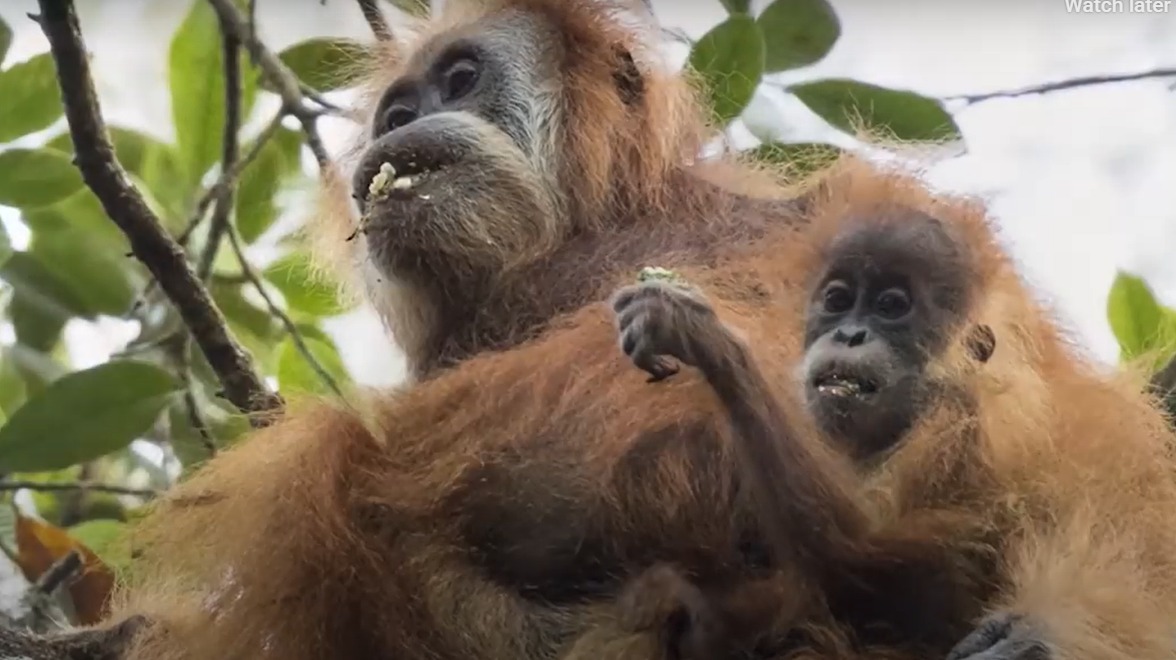
The Tapanuli orangutan (Pongo tapanuliensis) was only recognized as a distinct species in 2017 and exists in the wild in a fragile pocket of rainforest in North Sumatra. With fewer than 800 individuals remaining, the species was already perilously close to extinction before the disaster.
Disaster in the Forest
Late November’s extreme rainfall — fueled by a powerful cyclone and exacerbated by climate change — triggered floods and landslides that tore across the Batang Toru forest, obliterating entire swaths of habitat. Scientists describe the event as an “extinction-level disturbance” for the Tapanuli orangutan. Satellite imagery reveals massive landslide scars stretching over kilometers, ripping apart forested slopes where these apes once thrived.
Preliminary scientific estimates suggest that between 6 % and 11 % of the orangutan population in the crucial West Block habitat may have been killed in just a few days — a demographic shock of unprecedented scale for any great ape species. Considering the orangutans’ slow reproduction cycle of six to nine years, even losses above 1 % per year could accelerate a path toward extinction.
A carcass believed to be that of a Tapanuli orangutan was pulled from mud and debris in the disaster zone — a stark symbol of the crisis. Conservationists say it may represent only a fraction of the animals lost.
Vanished from the Canopy
In parts of the flood-ravaged forest — such as Sipirok in South Tapanuli — rangers and humanitarian workers report an eerie silence where there was once the sound of long calls and movement through the canopy. Before the floods, Tapanuli orangutans were regularly seen feeding on fruits and travelling across branches. After the disaster, they were nowhere to be seen — an absence that has alarmed those who have spent years studying and protecting the species.
One ranger described how orangutans “must have moved away, further and further” as their habitat was destroyed, while others speculate that many may not have survived unscathed beneath uprooted trees and swept-away forest floor.
Human and Environmental Factors Collide
The calamity in Batang Toru did not occur in a vacuum. For years, development pressures — logging, mining, palm oil plantations, and hydroelectric projects — had already fragmented the forest, stripping natural buffers and weakening hillside integrity. This fragmentation not only reduced the space available to the orangutans but likely made the landscape far more vulnerable to catastrophic landslides and floods.
Experts warn that deforestation not only destroys habitat but can amplify the severity of extreme weather events, a dangerous synergy of environmental exploitation and climate-driven storms.
Calls for Urgent Action
The crisis has galvanized conservationists and scientists to demand immediate, decisive measures:
Comprehensive surveys to establish the true extent of population losses and habitat destruction.
Expanded protection of remaining forest and legally binding conservation zones.
Restoration efforts to reconnect fragmented habitats and rebuild ecological corridors.
A halt to further destructive development in and around the Batang Toru ecosystem.
As Panut Hadisiswoyo, founder of the Orangutan Information Centre, put it: “This fragile and sensitive habitat in West Block must be fully protected.”
More Than a Wildlife Story
The plight of the Tapanuli orangutan is a poignant reminder of how climate disasters and human activity are entwined — a microcosm of a global biodiversity crisis.
The silence now hanging over parts of Batang Toru’s forests — once filled with the rustle of leaves and the calls of an ancient lineage of great apes — tells a story of ecological loss that extends far beyond a single species. With habitat shattered and numbers dwindling, the next chapter for this extraordinary primate will depend on swift and sustained global conservation efforts.