The Orang Utan Republik Foundation is pleased to announce that Oktaviana Sawitri has been selected as the 2026 recipient of the LP Jenkins Memorial Fellowship. Oktaviana is currently pursuing her S2, a Master’s Degree in Geography, at Universitas Gadjah Mada in Yogyakarta, Indonesia. Her fellowship-supported research will focus on one of the most urgent challenges facing orangutan conservation today: understanding where human activity and orangutan habitat are most likely to collide.
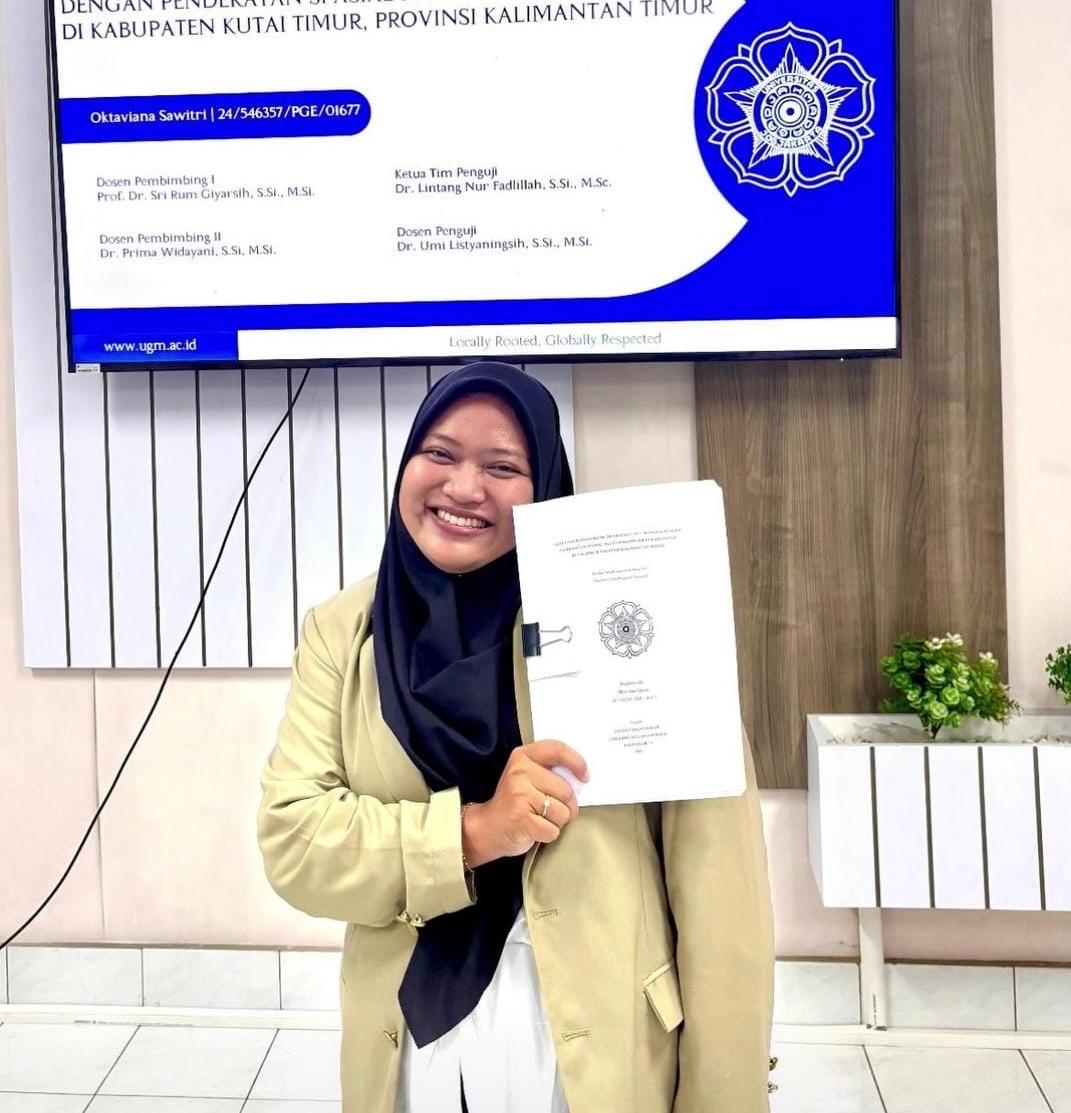
Oktaviana is already well known to OURF through her conservation leadership in East Kalimantan. As part of the Centre for Orangutan Protection (COP), she has served as manager of the East Borneo Orangutan Caring Scholarship program (EBOCS), helping support the next generation of Indonesian students committed to orangutan conservation. Her fellowship award therefore represents a meaningful continuation of her work: from helping students pursue conservation education to now advancing her own graduate research for the benefit of orangutans and forest communities.
Her proposed study, titled Spatial Analysis of Potential for Orangutan–Human Conflict Based on Habitat Suitability in East Kutai Regency, will use Geographic Information Systems, remote sensing, and spatial modeling to identify areas in East Kalimantan where orangutans remain dependent on suitable habitat but are increasingly exposed to roads, settlements, agriculture, deforestation, and other human pressures.
East Kutai is a critical landscape for this work. The regency still contains important Bornean orangutan habitat, yet it is also experiencing rapid land-use change from plantations, mining, infrastructure development, and expanding settlements. As forests become fragmented, orangutans are pushed closer to human-managed landscapes, increasing the risk of conflict, crop damage, displacement, injury, and death.
Oktaviana’s research seeks to move beyond simply mapping where orangutans can live. She will also examine where suitable orangutan habitat overlaps with areas of intense human pressure. By integrating habitat suitability with conflict-risk indicators, her work will help identify priority hotspot areas where conservation intervention may be most urgently needed.
Using satellite imagery, including Landsat and higher-resolution PlanetScope data, Oktaviana will assess vegetation condition, forest fragmentation, proximity to rivers, slope, roads, settlements, agricultural areas, and deforestation zones. These data will be used to produce maps showing suitable orangutan habitat, areas of low to high conflict potential, and integrated priority zones for mitigation and planning.
The expected results will have direct value for conservation practitioners, government agencies, and local stakeholders. Her maps can help guide habitat protection, ecological corridor planning, conflict monitoring, community-based prevention, and more informed land-use decisions in East Kutai.
Oktaviana brings strong preparation to this work. Since 2016, she has worked as a GIS specialist in the conservation sector, supporting biodiversity and environmental management projects through habitat mapping, land-cover analysis, remote sensing interpretation, and spatial modeling. She also serves as an ArcGIS trainer for students, researchers, and professionals, giving her both technical skill and the ability to communicate complex spatial information clearly.
The LP Jenkins Memorial Fellowship will help support the research activities and satellite imagery needed to complete this study at a high scientific standard. More importantly, it will help strengthen the next generation of Indonesian conservation researchers who are applying advanced tools to real-world orangutan protection.
Through her S2 research, Oktaviana is working toward a future in which conservation decisions are guided by evidence, landscapes are planned with greater care, and people and orangutans have a better chance of coexisting in one of Indonesia’s most important forest regions.